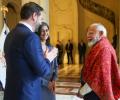
Vance is expected to be accompanied by at least five senior officials, including from the Pentagon and the State Department, the people cited above said.
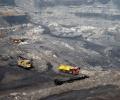
The 17 rare earth elements that are at the centre of the current crisis are critical components of everyday products -- from cars to jet engines to electronics like smartphones and flat-screen TVs.

Prime Minister Narendra Modi concluded his visit to the United States after holding high-level bilateral talks with President Donald Trump on a wide range of subjects, including trade and technology, defence and security, energy and people-to-people ties. The two leaders decided to take a significant step in deepening their strategic ties, particularly in the areas of defence, energy, and critical technology. Modi also met with key American officials, including National Security Advisor Michael Waltz and Director of National Intelligence Tulsi Gabbard, and prominent business leaders like SpaceX CEO Elon Musk and Indian-American entrepreneur Vivek Ramaswamy.
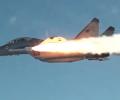
The Directors General of Military Operations of India and Pakistan firmed up the arrangement on stopping military actions on May 10 after four days of fierce offensives between the two sides that triggered fears of a wider conflict.

The disengagement process from both the north and south banks of Pangong Lake was completed by the two nations and further disengagement is underway at other friction points.
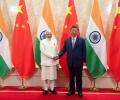
Prime Minister Narendra Modi and Chinese President Xi Jinping held bilateral talks focusing on economic ties and global stability amid trade tensions and the aftermath of the Ladakh border row.

Prime Minister Narendra Modi is deeply concerned by the war in Ukraine and his meeting with President Volodymyr Zelenskyy in New York demonstrates his commitment to finding a way forward and contributing in any way possible to a resolution of the conflict, Foreign Secretary Vikram Misri said.
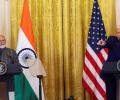
United States President Donald Trump on Thursday announced the extradition of the 26/11 Mumbai terror attack accused Tahawwur Rana to India and said he will face justice.
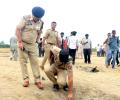
Indian Armed Forces brought down a number of these drones using kinetic and non-kinetic means.
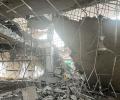
Indian Air Force S-400 Sudarshan Chakra air defence missile systems were fired last night against targets moving towards India. The targets were successfully neutralised in the operation multiple domain experts told ANI.

Prime Minister Narendra Modi on Tuesday conveyed to Russian President Vladimir Putin that India stands ready to provide all possible cooperation towards ending the Russia-Ukraine conflict and that dialogue and diplomacy is the only way to bring peace to the region.
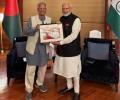
In his first meeting with Bangladesh Chief Adviser Muhammad Yunus, Prime Minister Narendra Modi on Friday flagged concerns over the attacks on minorities, including Hindus and conveyed that any rhetoric that vitiated the environment was best avoided.

Interacting with the Indian diaspora in Kuala Lumpur, Banerjee said, "We have been in talks with them (Pakistan) for decades, despite changes in various paradigms and governments. But one thing remains constant, the conflict with Pakistan."

India and China have held their first diplomatic talks since withdrawing troops from two face-off points in eastern Ladakh, reflecting on the lessons learned from the border row to prevent future incidents. The two sides agreed to maintain peace and tranquillity in border areas, prepare for the next meeting of Special Representatives on the boundary question, and highlighted the importance of regular exchanges and contacts at diplomatic and military levels. The talks come after the completion of the disengagement process from the last two friction points, following an agreement finalized in October 2022.
'What signal would we be sending -- that we don't stand by our friends?'

Union minister Kiren Rijiju on Friday said he interacted with soldiers of China's People's Liberation Army along the Sino-Indian border near Tawang during a visit to an Indian Army post on Diwali.

The exchange took place at five Border Personnel Meeting points along the LAC, the sources added.
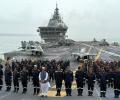
In an interaction with naval warriors on board aircraft carrier INS Vikrant off Goa, Singh sent a stern warning to Islamabad saying India will not hesitate to use the methods to deal with terrorism that Pakistan cannot even think of.
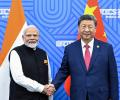
India and China celebrated the 75th anniversary of their diplomatic relations on Tuesday, with leaders from both countries exchanging congratulatory messages. The anniversary comes as the two countries are working to restore ties after a four-year freeze due to the military standoff in eastern Ladakh. Both countries have expressed a willingness to enhance strategic mutual trust and step up cooperation in various fields. The two sides are also exploring ways to rebuild ties and promote people-to-people exchanges.
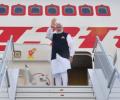
New initiatives to boost cooperation to ensure stability in the Indo-Pacific, ways to find peaceful solutions to the conflicts in Ukraine and Gaza and addressing concerns of the global South will be the focus of Prime Minister Narendra Modi's three-day visit to the US beginning Saturday.
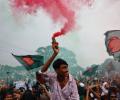
'Militants are taking over the administration. Fundamentalists have been released from jail.'
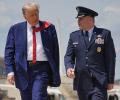
He then went on to say that, however, he won't get a Nobel Peace Prize for any of his efforts.

Prime Minister Narendra Modi has held talks with Ukrainian President Volodymyr Zelenskyy and reiterated India's commitment for an early resolution of the conflict in Ukraine and the restoration of peace and stability in the region.
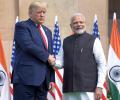
Prime Minister Narendra Modi and US President Joe Biden will have a substantive engagement on the sidelines of the Quad summit on Saturday, and the two sides will sign at least two agreements following the talks.
He went on to say that even though this has not been discussed, he is going to 'increase trade substantially with both of these great Nations.'
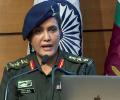
Being a 'fauji' kid, Sofiya Qureshi grew up listening to tales of valour and sacrifice of the army shared by her grandfather, who was a soldier.
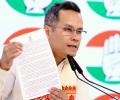
Newly appointed Assam Congress chief Gaurav Gogoi has denied allegations of having links to the Pakistani establishment, calling the claims made by the BJP a "C-grade Bollywood movie" that will "flop miserably." Gogoi said he had only visited Pakistan once 12 years ago with his wife, who was working on an international project focused on climate change. He questioned why the BJP government had not acted on the allegations in the past 11 years if there was any wrongdoing. Assam Chief Minister Himanta Biswa Sarma, who made the initial allegations, said he would release further evidence on September 10 after a Special Investigation Team (SIT) completes its inquiry.
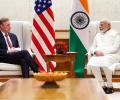
Prime Minister Narendra Modi on Monday met US National Security Advisor Jake Sullivan in New Delhi.
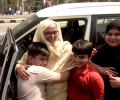
Following a deadly terror attack in Pahalgam, India has ordered all Pakistani nationals to leave the country within 48 hours. This has led to a mass exodus of Pakistani citizens from India, while several women married to Pakistani nationals and holding Indian passports are facing difficulties returning to their families in Pakistan.

Meanwhile, a precautionary blackout has been enforfced in the multiple areas amid the esclating tensions between India and Pakistan.
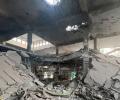
In a strong retaliation to the Pahalgam massacre, India's armed forces early Wednesday destroyed nine terror sites including that of Jaish-e-Mohammad and Lashkar-e-Taiba in Pakistan and Pakistan-occupied Kashmir (PoK) using deep strike missiles in a 25-minute-long 'measured and non-escalatory' mission.

In their first structured bilateral talks in nearly five years, Prime Minister Narendra Modi and Chinese President Xi Jinping Wednesday agreed that India and China can have a 'peaceful and stable' relationship by displaying maturity and mutual respect and endorsed the pact on the resolution of the dragging eastern Ladakh border row.

India and the United States have announced a groundbreaking 10-year defence partnership, paving the way for increased military cooperation and potential sales of F-35 stealth fighter jets. The agreement aims to bolster both countries' defence capabilities in the Indo-Pacific region, with plans for joint production of weapons and platforms. The move comes amid China's growing military presence in the region.

The ministry of external affairs also seemed to reject Trump's forceful comments that Washington brokered the understanding between India and Pakistan on ending their four-day military conflict.

China does not have to give up what it took in 2020, it will never give up its claim to Arunachal Pradesh, Ladakh and other areas, and it has all the time now to plan its next surprise, points out Lieutenant General Prakash Katoch (retd).

According to Misri's statement, Modi said he could not accept the invitation due to a pre-existing schedule, and invited Trump to visit India for the Quad Summit, likely later this year.

China on Tuesday confirmed that it has reached an agreement with India to end the standoff between the two armies in eastern Ladakh.
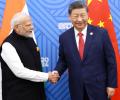
Chinese President Xi Jinping on Wednesday pledged to strengthen the strategic relationships with neighbouring countries by 'appropriately' managing differences and enhancing supply chain ties as China's tariff war with the United States escalated.
Chinese Foreign Minister Wang Yi said on Friday that India-China relations have made positive strides and achieved a series of encouraging outcomes at all levels after last year's breakthrough ending the over four-year-long military standoff in eastern Ladakh. Wang's remarks came during his annual press conference as he replied to a question on how Beijing views the course of bilateral ties after the two countries ended the prolonged stalemate in the ties.
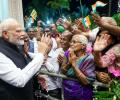
Prime Minister Narendra Modi's visit to Sri Lanka is expected to yield at least 10 ambitious outcomes, including a defense cooperation agreement and frameworks for deeper engagement in the energy sector. The visit comes at a time when Sri Lanka is recovering from an economic crisis, with India providing significant financial assistance. Modi and Sri Lankan President Anura Kumara Dissanayake will also dedicate several projects built with India's assistance and virtually inaugurate the Sampur solar energy project.
